
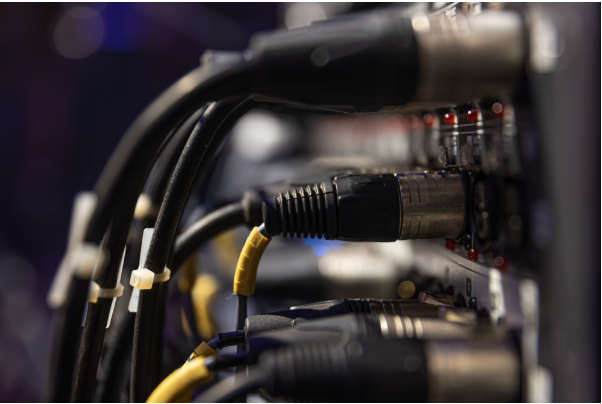


Cisco cables are basically management and connection cords that network administrators use to configure and troubleshoot routers and switches. Unlike standard Ethernet cables that transfer data, a classic Cisco console cable connects a computer directly to a device’s console port.
Depending upon the hardware interface, Cisco networks use a variety of copper, fiber, or specialized cables. In today’s article, we’ll be discussing these types in detail.
Let’s get started.
Cisco Cab HD8 Async Cable
The Cisco Cab HD8 Async cable is a high-density, octal-breakout asynchronous cable. It is used to connect Cisco network modules with terminal servers to multiple serial devices.
Connector 1 on this cable is a 68-pin VHDCI/HPDB68 male connector that connects to the Cisco router. Connector 2 consists of 8 individual RJ-45 Male connectors for connecting external equipment. The standard length of this cable is 3 meters, and the jacket is usually green or black.
This cable maintains the same pinout as older octal configurations, allowing compatibility with standard RJ-45-to-console adapters.
Management and Console Cables
So, these are specialized cords used to connect a computer directly to a router or firewall. They help the operator manage devices directly.
For example, the Rollover (Console) Cable features reversed pinouts (1-to-8). It is generally used to connect an RJ-45 port on a computer or terminal server to the management console port of a Cisco router.
We then have an RJ-45-to-DB-9 Adapter Cable. It’s a two-piece molded flat blue console cable that connects a legacy 9-pin serial computer port to an RJ-45 console port.
In this category, the USB-to-RJ-45 cable is a modern management cable that plugs directly from a laptop’s USB port into a Cisco device’s console port. It doesn’t need a serial adapter.
Ethernet and Data Network Cables
These are physical copper or fiber cables used to connect devices in a Local Area Network. They can also be used to manage Cisco enterprise networking hardware.
In this category, we first have standard twisted-pair copper cable. It is wired identically at both ends and is used to connect different types of devices, such as a router or PC to a switch.
The swapped-pinout cable has historically been used to connect similar devices (switch to switch or router to router) directly. But most modern Cisco interfaces support Auto-MDI, which makes these cables almost obsolete.
To connect devices over long distances, single-mode or multimode fiber cables are also used.
Specialized and Serial Cables
These are dedicated connection lines that configure, monitor, and link networking hardware rather than carry the everyday data.
Here, we first have proprietary 26-pin Cisco cables that break out to standard WAN interface connectors such as V.35 or X.21.
Next, Twinax cables are passive or active copper cables with integrated SFP+ connectors at both ends. These are used for short-range stacking or switch-to-switch links.
Final Thoughts
Which cable you exactly need depends on your unique networking requirements. You can even consult with a network engineer to simplify this decision-making for you.